Related

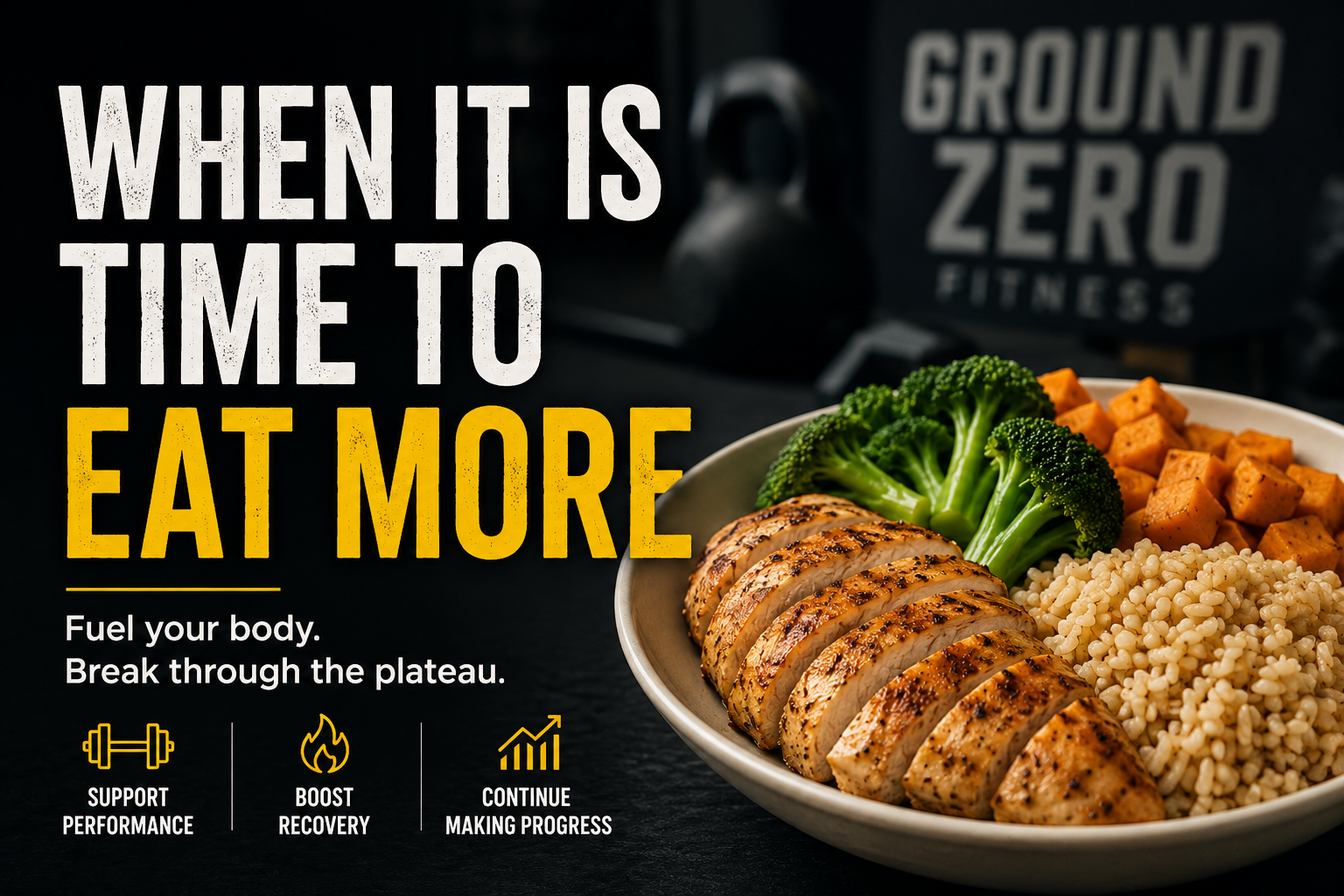
When It's Time to Eat More
You've been doing everything right.
You're showing up to workouts. You're getting your steps in. You're drinking your water. You're tracking your food.
The scale started moving, your clothes fit better, and you felt like you were finally making progress.
Then suddenly...
Nothing.
The scale won't budge. Your energy is low. Your workouts feel harder. You're hungry all the time. No matter how much effort you're putting in, fat loss seems to have hit a brick wall.
Sound familiar?
It might be time to eat more.
Wait... Eat More to Lose Weight?
At first, that sounds backwards.
Most people believe fat loss is simply a matter of eating less and moving more. While creating a calorie deficit is necessary for weight loss, there comes a point where continually cutting food isn't always the answer.
Your body is an incredibly smart machine.
Its number one job is survival.
When calories stay too low for too long, your body begins adapting. It starts conserving energy, reducing movement, slowing recovery, increasing hunger signals, and making fat loss more difficult.
In other words, your body starts fighting back.
Not because it's broken.
Because it's doing exactly what it was designed to do.
Signs You May Need More Food
If you've been dieting for a while and notice several of these signs, it may be time to increase your calorie intake:
- Weight loss has stalled for 3-4 weeks or longer
- Energy levels are consistently low
- Workouts feel harder than normal
- Recovery takes longer
- Hunger is constantly high
- Sleep quality has decreased
- You're feeling irritable or moody
- Strength numbers are dropping
Many people see these signs and immediately decide to eat even less.
That's usually when the cycle gets worse.
A Real-World Example
Let's say Sarah starts her fat loss journey eating 2,000 calories per day.
She loses 15 pounds over several months and feels great.
When progress slows, she cuts to 1,800 calories.
Then 1,600.
Then 1,400.
Eventually, she's exhausted, hungry, and frustrated because the scale still isn't moving.
At that point, the solution may not be another calorie cut.
Instead, Sarah might benefit from gradually increasing calories back up to 1,800 or even 2,000 calories while maintaining good food quality and consistent training.
This gives her body a chance to recover, improve performance, and restore the metabolic adaptations that occurred during the prolonged diet.
Sometimes you need to feed the body before asking it to continue losing body fat.
Eat More of the Right Things
Let's be clear.
Eating more doesn't mean turning every meal into pizza and ice cream.
It means increasing the foods you're already eating.
Think:
- More lean protein
- More fruits and vegetables
- Larger portions of rice, potatoes, oats, or whole grains
- Healthy fats like avocado, nuts, and olive oil
If your breakfast is normally two eggs and fruit, maybe it becomes three eggs.
If you're having a cup of rice at dinner, maybe it becomes a cup and a half.
Small adjustments can make a big difference.
Tactics to Break Through a Plateau
1. Stop Chasing Lower Calories
Before cutting food again, honestly assess how long you've been dieting.
If you've been in a calorie deficit for months, your body may benefit from a period of maintenance calories.
2. Focus on Performance
Instead of obsessing over the scale, pay attention to:
- Strength gains
- Energy levels
- Recovery
- Workout consistency
When performance improves, fat loss often follows.
3. Increase Calories Slowly
You don't need to double your food overnight.
Start by adding 100-200 calories per day from quality food sources and monitor how you feel.
4. Prioritize Protein
Protein supports muscle retention, recovery, and satiety.
Aim to include a quality protein source at every meal.
5. Trust the Process
Many people panic when the scale doesn't move for a week or two.
Remember that fat loss is rarely linear.
Sometimes the body needs a little more fuel before it's willing to let go of more body fat.
The Bottom Line
Fat loss isn't about starving yourself.
It's about creating the right environment for your body to succeed.
If you've been stuck for weeks, feeling exhausted, and constantly trying to eat less, it might be time to consider the opposite approach.
Eat more of the foods that are already supporting your goals.
Fuel your workouts.
Recover properly.
Trust the process.
Because sometimes the fastest way to keep losing body fat is to stop trying to eat as little as possible.
Ready to Stop Guessing?
If you're in the Fairmont area and tired of spinning your wheels and wondering whether you should eat more, eat less, or completely change your plan, we're here to help.
Book a FREE No Sweat Intro and sit down with one of our coaches. We'll learn about your goals, discuss what's currently working (and what's not), and create a simple plan that fits your lifestyle.
No workouts. No pressure. Just a conversation.
Schedule your FREE No Sweat Intro today:
https://api.grow.pushpress.com/widget/bookings/gz-fitness-nsi
Let's build a plan that actually works for you.
.png)








.png)



.png)
.png)
.png)
.png)
.png)

.png)






-2.png)
.png)


-8.png)