Related

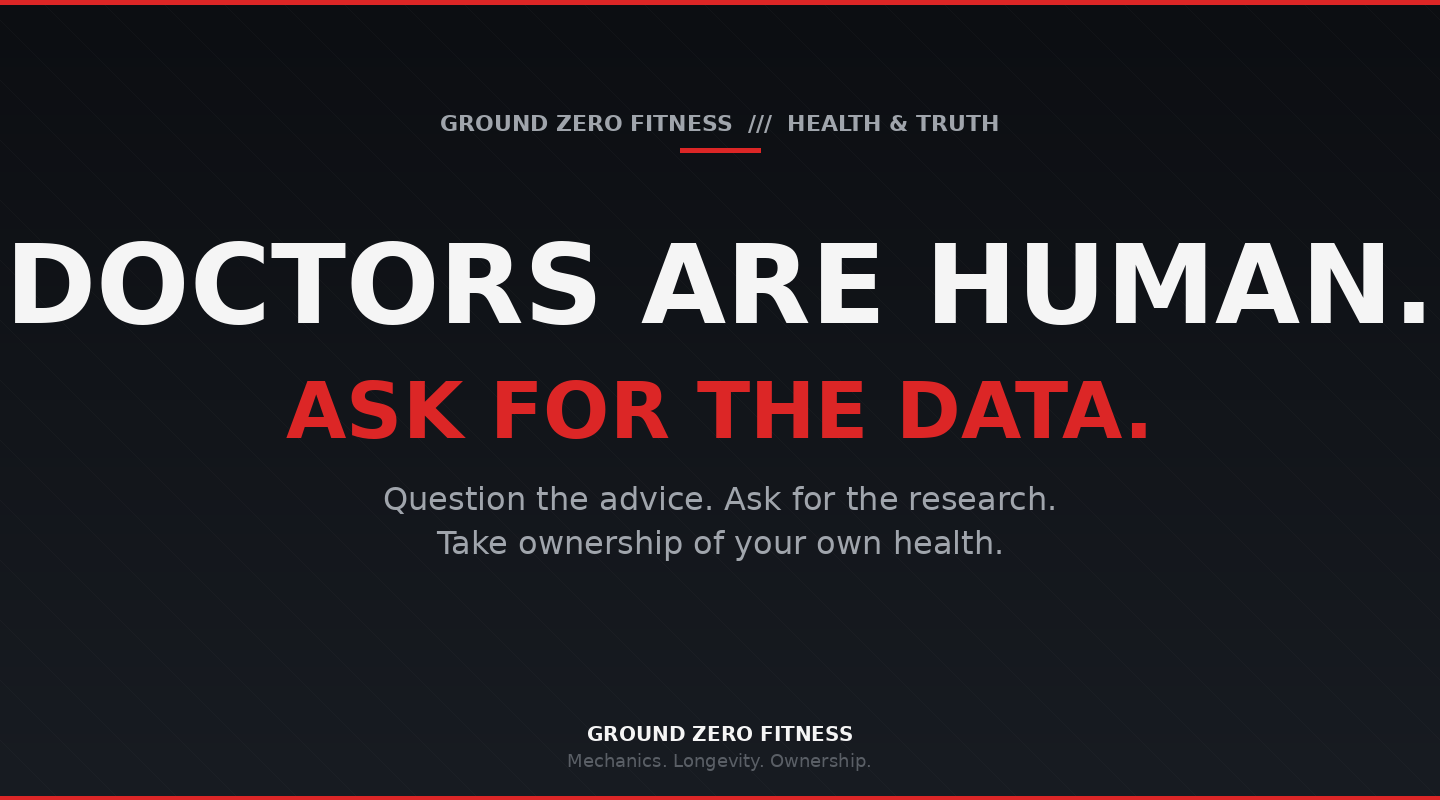
Doctors Are Human: Why You Should Always Ask for the Data
Let me say something up front that I want every member, every client, and every reader to take to heart: doctors are human beings.
They went to school. They studied hard. They earned the white coat. And they deserve respect for the work they do. But they are not gods, they are not infallible, and they are not the final authority on your body. They are people — people who learned what their textbooks taught them, who follow the guidelines handed down by committees, who get the same pharmaceutical sales pitches as every other physician in their network, and who sometimes practice medicine that turns out, years later, to have been dead wrong.
That's not a knock on doctors. That's just the truth.
The good news? You can do something about it. You can ask questions. You can ask for the research. You can request the data behind the recommendation. You can say, "Where did you get that from?" and "Has that been challenged?" and "What does the latest evidence actually show?"
A good doctor will respect those questions. A great doctor will welcome them. And if a doctor gets defensive, dismissive, or annoyed because you want to understand your own health — that tells you everything you need to know about whether they're the right doctor for you.
Here's a simple example I use with my members. If a doctor tells you that you're "not allowed to squat" because of your knees, your back, or your age — ask them how, exactly, you're supposed to get up out of a chair. Or off the toilet. Or out of your car. Squatting isn't an exercise. It's a fundamental human movement pattern. If you stop doing it, you lose the ability to do it. And once you lose the ability to do it, you lose your independence.
That doesn't mean the doctor is wrong. Maybe there's a real reason to modify how you train. But you deserve to understand the why — and you deserve a path forward, not just a list of things you can't do.
The history of modern medicine is full of examples of "settled" advice that turned out to be wrong. Not minor, niche stuff. Huge, consequential, life-and-death advice given to millions of people. Let's walk through some of the biggest ones — with the receipts — so you can see exactly why it pays to question, ask, and verify.
"More Doctors Smoke Camels Than Any Other Cigarette"
That was a real ad slogan. In the 1940s and 50s, cigarette companies put physicians in their advertisements. Doctors recommended specific brands to patients. Cigarettes were handed out in hospitals. Lucky Strike ran ads claiming that "20,679 physicians say Luckies are less irritating."
It wasn't until the 1964 Surgeon General's Report that the medical establishment officially acknowledged what we now consider obvious: smoking causes lung cancer, heart disease, stroke, and dozens of other illnesses. Cigarettes are one of the most addictive substances on the planet. Nicotine hijacks your brain's reward system in a way that makes quitting brutal — even when smokers know it's killing them.
Today, smoking is the leading preventable cause of death in the United States. The same product doctors once endorsed kills nearly half a million Americans every year.
Think about that the next time someone tells you something is "doctor recommended."
Sources:
- CDC History of the Surgeon General's Reports on Smoking and Health: https://www.cdc.gov/tobacco-surgeon-general-reports/about/history.html
- The 1964 Report on Smoking and Health (National Library of Medicine): https://profiles.nlm.nih.gov/spotlight/nn/feature/smoking
- "Doctors Smoking" historical advertising archive (Stanford School of Medicine): https://tobacco.stanford.edu/cigarette/doctors-smoking/
The AIDS Crisis: A Failure of Information
When HIV/AIDS emerged in the early 1980s, the medical and public health response was a mess. The disease was initially called "GRID" — gay-related immune deficiency — which framed it as a problem affecting only one community and delayed urgent research. Worse, in the early years, official messaging on transmission was confused, contradictory, and sometimes flat-out wrong.
People were told you could potentially catch HIV from toilet seats, drinking fountains, mosquito bites, or casual contact. Patients were refused care. Children with HIV were barred from schools. Funeral homes refused to handle the bodies. Families were torn apart by fear that turned out to be based on misinformation, not science.
The reality — that HIV is transmitted through specific routes like unprotected sex, shared needles, blood, and from mother to child — took years to communicate clearly to the public. By then, the damage was done. Stigma, fear, and delayed action cost an enormous number of lives.
Sources:
- CDC HIV Basics — How HIV Is Transmitted: https://www.cdc.gov/hiv/basics/transmission.html
- "A Timeline of HIV and AIDS" (HIV.gov): https://www.hiv.gov/hiv-basics/overview/history/hiv-and-aids-timeline
- "The History of the HIV/AIDS Epidemic" (NIH National Library of Medicine): https://www.ncbi.nlm.nih.gov/pmc/articles/PMC4351368/
OxyContin: "Less Than 1% Addictive"
In the mid-1990s, Purdue Pharma launched OxyContin and aggressively marketed it to doctors as a safe, effective long-acting opioid for chronic pain. The pitch? That the risk of addiction was "less than 1%."
That number was a lie. It came from a misrepresented 1980 letter to the editor in the New England Journal of Medicine — not a study, not a clinical trial, just a single paragraph observation. Purdue's sales reps used it to convince physicians that OxyContin was fundamentally different from other opioids and could be prescribed liberally for everything from back pain to dental work.
Doctors trusted them. They prescribed it by the millions.
The result is a public health catastrophe that's still unfolding. More than 800,000 Americans have died from drug overdoses since 1999. Entire communities — including many right here in West Virginia and across Appalachia — have been gutted by an epidemic that started in a doctor's office with a prescription pad.
The lesson isn't that pain shouldn't be treated. It's that "doctor recommended" and "FDA approved" don't mean what we want them to mean. Trust, but verify.
Sources:
- "The Promotion and Marketing of OxyContin: Commercial Triumph, Public Health Tragedy" (American Journal of Public Health): https://www.ncbi.nlm.nih.gov/pmc/articles/PMC2622774/
- CDC Understanding the Opioid Overdose Epidemic: https://www.cdc.gov/overdose-prevention/about/understanding-the-opioid-overdose-epidemic.html
- "Addiction Rare in Patients Treated with Narcotics" — the misused 1980 Porter and Jick letter (NEJM): https://www.nejm.org/doi/full/10.1056/NEJM198001103020221
The Low-Fat Lie
Now we get to the one that affects almost every person reading this.
In the 1950s, a researcher named Ancel Keys promoted what became known as the "diet-heart hypothesis" — the idea that saturated fat caused heart disease by raising cholesterol. By the 1980s, this idea had been baked into U.S. Dietary Guidelines. Americans were told to cut fat from their diet. Period.
Food companies responded the way food companies always do. They stripped fat out of everything — yogurt, salad dressing, peanut butter, cookies, milk — and replaced it with sugar and refined carbohydrates to make it taste palatable. SnackWell's, fat-free Pop-Tarts, low-fat granola bars loaded with high-fructose corn syrup. An entire generation grew up eating this stuff.
What happened? Obesity rates exploded. Type 2 diabetes rates exploded. Metabolic disease became the new normal.
And here's the kicker: more than 20 modern review papers have now concluded that saturated fat has no clear effect on heart attacks, strokes, or cardiovascular mortality. The whole foundation of the "low-fat is healthy" message was built on shaky science that didn't hold up. Yet the dietary guidelines have been slow to catch up, and most Americans are still operating on 1980s nutritional advice.
Sources:
- "Dietary Saturated Fats and Health: Are the U.S. Guidelines Evidence-Based?" (Nutrients, 2021): https://www.ncbi.nlm.nih.gov/pmc/articles/PMC8541481/
- "Saturated Fats and Health: A Reassessment and Proposal for Food-Based Recommendations" (JACC State-of-the-Art Review): https://www.jacc.org/doi/10.1016/j.jacc.2020.05.077
- "A short history of saturated fat: the making and unmaking of a scientific consensus" (Current Opinion in Endocrinology, Diabetes and Obesity): https://www.ncbi.nlm.nih.gov/pmc/articles/PMC9794145/
Eggs and the Cholesterol Myth
For decades, eggs were public enemy number one. Doctors told patients with high cholesterol to limit eggs to two or three per week — sometimes to avoid them entirely. The yolk, in particular, was demonized for its cholesterol content.
Here's what the science actually shows: dietary cholesterol — the cholesterol you eat — has very little impact on blood cholesterol for most people. Your liver produces the vast majority of the cholesterol in your body, and it adjusts production based on what you eat. Eat more cholesterol, your liver makes less. Eat less, it makes more.
In 2015, the U.S. Dietary Guidelines officially removed the 300 mg daily cap on dietary cholesterol. The American Heart Association acknowledged that the evidence linking dietary cholesterol to cardiovascular disease wasn't there. Eggs were quietly rehabilitated.
Sources:
- "Dietary Cholesterol and Cardiovascular Risk: A Science Advisory From the American Heart Association" (Circulation): https://www.ahajournals.org/doi/10.1161/CIR.0000000000000743
- 2015–2020 Dietary Guidelines for Americans: https://health.gov/our-work/nutrition-physical-activity/dietary-guidelines/previous-dietary-guidelines/2015
- "Dietary saturated fat and cholesterol: cracking the myths around eggs and cardiovascular disease" (Journal of Nutritional Science): https://www.ncbi.nlm.nih.gov/pmc/articles/PMC10495817/
But here's the part most people still don't understand:
Good Cholesterol vs. Bad Cholesterol
Cholesterol isn't a single villain. It's a critical molecule your body uses to build cell membranes, produce hormones (including testosterone and estrogen), make vitamin D, and create bile for digestion. You literally cannot live without it.
When doctors talk about cholesterol, they're usually talking about two main types:
LDL (Low-Density Lipoprotein) — often called "bad" cholesterol. LDL carries cholesterol from your liver to your cells. When there's too much of it, particularly the small, dense LDL particles, it can contribute to plaque buildup in your arteries.
HDL (High-Density Lipoprotein) — often called "good" cholesterol. HDL acts like a cleanup crew, picking up excess cholesterol and bringing it back to the liver to be processed. Higher HDL is generally associated with better cardiovascular health.
But even this picture is more nuanced than it sounds. LDL particle size matters. Triglycerides matter. The ratio of HDL to triglycerides matters. Inflammation matters. Insulin resistance matters. The simple "high cholesterol = bad" framework that most people grew up with isn't wrong, exactly — it's just incomplete.
What actually drives cardiovascular disease is metabolic dysfunction: chronic high blood sugar, insulin resistance, inflammation, excess body fat (especially around the midsection), and poor cardiovascular fitness. You don't fix that with a low-fat cookie.
Sources:
- "LDL and HDL Cholesterol and Triglycerides" (American Heart Association): https://www.heart.org/en/health-topics/cholesterol/hdl-good-ldl-bad-cholesterol-and-triglycerides
- "Cholesterol" (NIH MedlinePlus): https://medlineplus.gov/cholesterol.html
- "Insulin Resistance and Cardiovascular Disease" (Journal of the American College of Cardiology): https://www.jacc.org/doi/10.1016/j.jacc.2020.07.044
So What Do You Actually Do With All This?
If you've read this far, you might feel a little overwhelmed. If doctors got smoking wrong, AIDS messaging wrong, OxyContin wrong, low-fat wrong, and eggs wrong — what can you trust?
Here's what I tell my members at Ground Zero Fitness: trust principles, not headlines.
The principles haven't changed in thousands of years. Eat real food. Move your body. Build strength. Sleep well. Manage stress. Maintain relationships. Don't smoke. Don't abuse substances. Take ownership of your own health.
That's it. That's the whole game.
The problem is that almost nobody actually executes those principles consistently. Not because they're complicated, but because life gets in the way and most people don't have anyone holding them accountable.
Where a Coach Comes In: Nutrition
This is where having a trainer or coach changes everything. A good coach doesn't just hand you a meal plan and disappear. A good coach helps you understand:
- What your body actually needs based on your age, your activity level, your goals, and your individual response to food.
- How to read past the marketing and the latest fad and focus on whole foods that have served humans well for generations.
- How to balance protein, fats, and carbohydrates in a way that fuels your training and supports your body composition goals.
- How to identify what works for you specifically. Some people thrive on more carbs. Some people feel better with more fat. Some people need more protein. Generic advice doesn't account for that.
- How to build a sustainable approach instead of crashing through diet after diet that nobody could maintain long-term.
When the official advice says "eat low fat" and the science later says "actually, that was wrong" — your coach is the person who's been paying attention to the actual research, the actual outcomes, and the actual results in real people's bodies.
Where a Coach Comes In: Exercise
Same thing applies to training. The fitness industry is full of bad advice — random workouts pulled from social media, programs designed for elite athletes being sold to beginners, machines that isolate muscles you'll never use in real life, and "no pain, no gain" thinking that gets people injured.
A good coach helps you:
- Build proper movement patterns before adding load, so your joints last for the long haul.
- Train for longevity, not just for how you look in the mirror this summer.
- Progress at the right pace — fast enough to see results, slow enough to avoid injury.
- Understand the "why" behind every exercise so you're not just going through the motions.
- Stay consistent because someone is expecting you to show up.
At Ground Zero Fitness, our entire approach is built around mechanics first. We work with middle to older-aged athletes who want to be strong, mobile, and capable for the next 30, 40, 50 years of their lives — not just look good for the next photo. That's a different conversation than what most gyms are having.
The Bottom Line
Doctors are human. The medical system is human. Both have been wrong about big things, sometimes for decades, often in ways that hurt millions of people. Smoking. AIDS messaging. OxyContin. Low-fat dogma. Cholesterol fear-mongering. The list goes on.
That doesn't mean you reject medicine. You absolutely should see your doctor, get your bloodwork done, and treat real medical issues. What it means is this: be an active participant in your own care. Ask questions. Ask for the research. Ask, "What's the source of that recommendation?" and "Has the evidence been updated?" and "What are my other options?"
If a doctor tells you to stop doing something, ask why. If they tell you to start something, ask why. If they tell you that you can't squat — ask them how you're supposed to stand up. You're not being difficult. You're being responsible.
The responsibility for your long-term health sits with you. Not with a guideline. Not with a headline. Not with a pharmaceutical company. With you.
And you don't have to figure it out alone.
Ready to Take Ownership of Your Health?
If you're tired of confusing advice, fad diets, and one-size-fits-all programs that don't work for real adults with real lives, let's talk. At Ground Zero Fitness, we coach you through the mechanics of proper movement and the fundamentals of real nutrition — so you can build a body that serves you for life.
Book your free intro session here: https://api.grow.pushpress.com/widget/bookings/gz-fitness-nsi
Stop guessing. Start training with intention.



.png)


















.png)




.png)
.png)




.png)
.png)

.png)

.png)

















-2.png)
.png)


-8.png)